
Soft Fields
A classic tale of petty crime and high adventure

February 21, 2019
I got kicked out of my college bar exactly one time. Just once. Actually it’s the only time I’ve ever been kicked out of any bar. Everyone always really wants me to stay.
I wish it was a great story about how I was beating up on the class bully or got caught embezzling fountain drinks to donate to local orphans but it was a lot more boring than that. I tried to steal a photograph.
There was only one bar within a mile of our campus because there are, apparently, too many elementary schools located in the same radius, which always made me wonder just how bad the local bouncers must be at evaluating people’s ages. That monopoly policy made this bar the sun of our school’s social system, so everyone gathered there most nights. The place was decorated how you’d expect, sports jerseys hung from the rafters, floors that your shoes stuck to, eclectic photographs throughout. They said if you proposed to your girlfriend at the bar, ring and everything, they would take a commemorative picture and put it up on the wall, and many young romantics used this policy to their benefit. My friend Trent holds the all time record. He’s on there three different times.1 Exhibitionist freak.
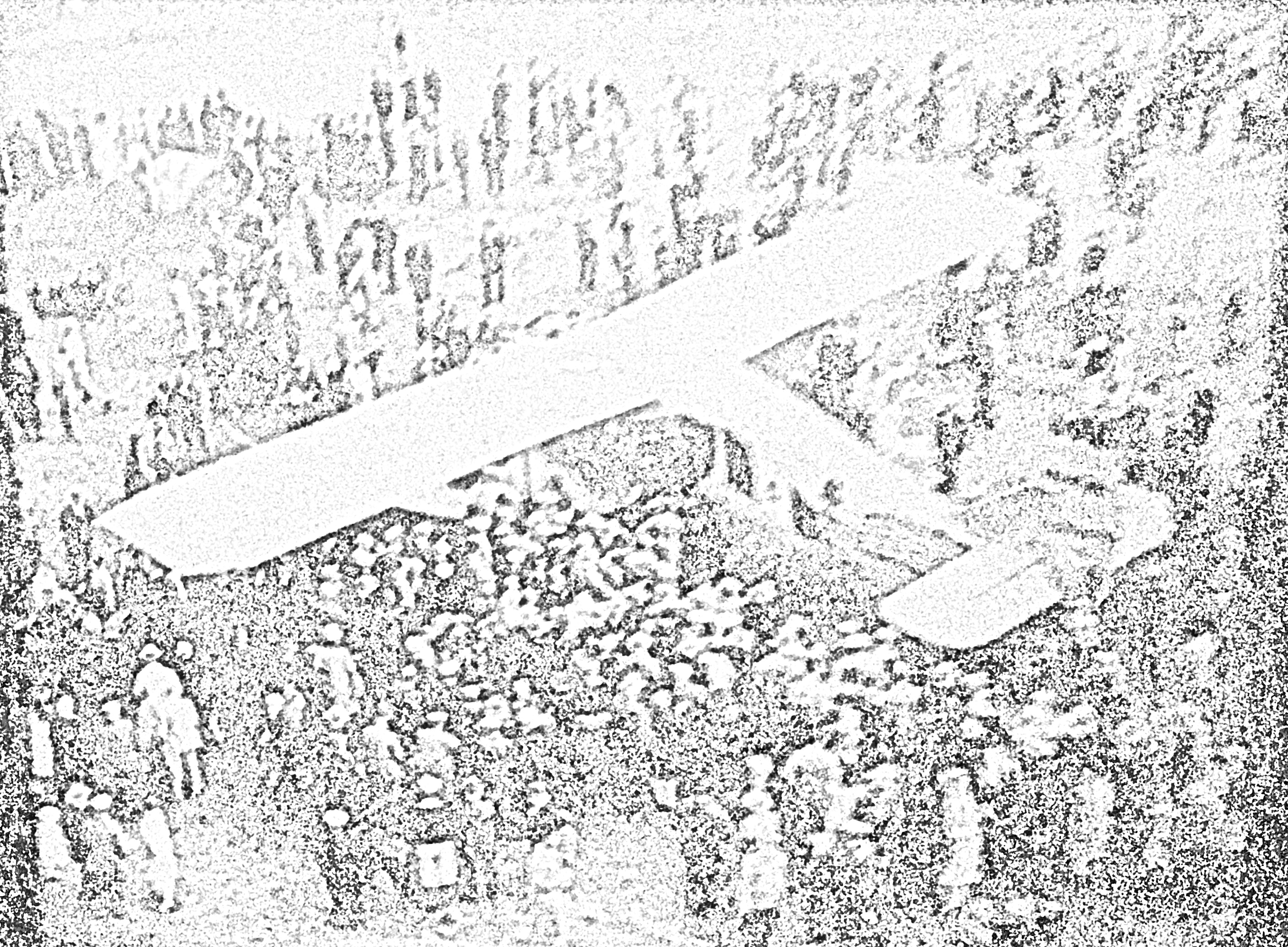
But the picture that I wanted to steal had nothing to do with drunken engagements. It was a black and white of an airplane, an old mid century high wing. Cessna-ish, something like a Super Cub or a Skywagon. The particulars of the model were not important but what was important was that the photo was taken from a high angle on a hill above a grassy area, where the plane was sitting calmly, surrounded by like five hundred people. 500. The wings and the fuselage were completely enveloped by the swarm. It looked like the plane was crowd surfing above them, like on the nature docs when you see an army of ants carrying a big leaf. I had so many questions.
Where was the pilot, was the crowd mad at him…or like worshipping him? Her? Earhart touching down in Ireland? Lindbergh press tour? Antoine?!?
I couldn’t look away from the photo, had to know every little detail about it, needed to solve all of its mysteries. I realized that that was gonna be pretty hard to do at 1am, double fisting AMFs while the bar played Old Town Road for the third time, so I figured I had better save all that critical thinking for a later occasion and I pulled the picture off of the wall.
I’m like an average sized guy, athletic in the right light, so it was pretty tough for me to hide a 16x20 frame inside my T-shirt. Security was on me quickly…if not for my robbery then at least for the 32 ounces of blue liquor that I had just dropped all over the floor. The two bouncers did the whole strobe flashlight thing, escorting me towards the door and confiscating my stolen photo, yet even in the face of this extreme humiliation I still found the decency to make conversation with my assailants.
“Gentlemen, if you have any passion at all for aeronautical history you’ll put me down this instant. If we work together I’m sure we could get to the bottom of this photograph. I think it might be a shot of Saint Exupery making his rounds in Argentina.”
They ignored my remarks and continued carrying me, one with my arms and the other with my legs like they were gonna toss me into the pool at summer camp. As we approached the threshold of the front door I remembered the other unsolved local mystery.
“And Mr. Bouncer sirs…before I depart I do have one more question…”
They made no acknowledgement but drunk-me could tell they were dying to hear what I had to say.
“Have you guys ever let any 5th graders in here by accident?”
That was the last thing I remember. The only evidence I have leftover from that night is a chronic headache that still returns whenever I see blue curacao, and this blurry picture I took in the moments before my crime.
Last Week
But you can’t keep a good thief down! So after taking years to replan every aspect of my heist, and fantasize over the hidden treasure buried inside that frame, I set off again on my big score.
First, a couple lessons that I learned from my initial attempt.
Be quick – I estimated that I had, at best, 10 seconds to get from the photo wall to the back door before the guards would be all over me. I’ve been hitting plyos pretty hard this summer and should be able to do it in half that time.
Work in the shadows – The entire front wall of the bar is mirrored glass and bright TVs. So many clear sightlines for my old bouncer nemeses to recognize me and thwart the operation. I’d need to stay low and hidden to avoid detection.
Dress for the occasion – A T shirt was not gonna cut it. No, we were gonna do it professional style.
Treat others how you want to be treated – No real reason for this one but always a good reminder.
In the intervening years I had snatched a plaid wool suit from my grandfather’s old closet (which has proved to be a hit at wedding rehearsal dinners both near and far) for the express purpose of aiding my future crimes of good intention. This, coupled with a quality bag and some thin eyeglasses, made me look the part of a genuine professor of anthropology – someone who, if pressed, would seem well fit to commandeer important photographs. But plan A was still to go for the clean steal and come out with the goods, undetected.
Fully prepared, I relived my youthful shenanigans for a night, sneaking into our old college bar with a satchel sized appropriately for the job. The thing was huge. Due to a small oversight on my part, I performed my re-heist on the same day of the week as the original, specifically on a Thursday during happy hour, meaning that the 2 for 1 special of the night was once again the ghastly blue AMF, which meant that each of the little poli sci majors in there had both palms full of that vile cocktail, making the same mistakes that I had years before. You can then imagine how I endured the added challenge of holding back a relentless gag reflex during the most crucial tactical mission of my life.
Even with the helpful guise of my Indiana Jones costume, I knew that I still couldn’t chance it on being recognized by the bouncer crew, so I snuck into the bar along the side, crouching down low, fighting the remembered nausea of hangovers past. I made it to the gallery wall in question and positively identified my target, that same photograph that had been hung in the back of my mind for so many years. It was a surreal moment to be reconnected to something that I had built up so much in my memory, but there was little time for introspection. I was here on business. In the midst of a feigned sneeze into my elbow I made a swooping arc with my other arm and in one elegant motion I seized the target of my studies. I then unleashed my plyometric potential and sprinted out the back door before any of the bouncers had even seen me.
With the frame in my possession, I went home to make several hi res scanned copies before returning the photograph to its rightful place on the gallery wall the next evening, since thieves make lousy friends, and what goes around comes around, and if I ever ran my own personal bar I’d be pretty pissed if some desperate writer kept ransacking my decor – unless of course he had a real winner of a story to tell, in which case I might let it slide once or twice.
I reverse image searched the scans (which I will obviously refrain from posting so as to avoid a litany of copyright and burglary lawsuits) and deep in the annals of a JSTOR journal from over half a century ago I was able to uncover the full story of the airplane photograph, the account of which is reproduced for you here below. I did include a hand drawn replica of the picture, since I believe it is an artistic enough reinterpretation so as to preclude legal action.
This 58 year old journal was lived and penned by one Ronald Watts, a former Royal Air Force officer turned bush pilot. Unfortunately his story, which explains all the mysteries of the photo from my college bar, could have used a better editor. It gets bogged down with the nitty gritty of airplane flying, stuff like angles of attack and lenticular clouds and dozens of pages dissecting the effects of relative humidity on the lift characteristics of air masses, not to mention another even longer digression where this Mr. Ronald Watts explained that the former Mrs. Ronald Watts left him for a matador in Valencia, intricately describing how for years thereafter the red colored portions of his engine gauge dials provided the expert pilot no small rage as a constant reminder of his heartbreak.
But, naturally, no sane person could possibly want to read all of that, so I took the time to edit Mr. Watts’s story down to just the good parts. I denoted the regions where I altered his text and put in some additional commentary, and I also converted the units out of metric because that’s just tiresome, all those prefixes.
Ronald named his flying story Soft Fields, which apparently is what pilots call grass, and I’ve grown to learn that there is no shame in reusing good titles, as long as the new Queen is equally worthy of the old crown, so I will permit myself to plagiarize the British airman in this small respect. If you keep reading until you’ve uncovered the secrets of this alluring photograph for yourself, I believe you’ll find that Watts was quite proficient and thoughtful as a pilot – but further, in the disciplines of vivid prose and charming dialogue, he also showed exceptional talents.
Soft Fields
Ghats Rainforest, India
April, 1967
When this day began I had no intentions of saving a village of small children. I would have quite preferred to have slept in. 5 days on holiday had proved a lovely respite that I was in no rush to interrupt, plus the flying weather had been mostly shit.
Alas, fate is a cruel mistress, so when she summoned me into action on this expedition, in the form of a radio call from a nurse in one of the high villages, I felt it only decent to oblige.
Of course I didn’t get her radio call. I was off base, like I said. But dispatch got the transmission a couple hours after sunrise and it went something like this.
“Village nurse to Kochi base, village nurse to Kochi base, emergency situ, require immediate assistance.”
“This is Kochi Air Service, go ahead.”
“I am at Anamudi village and require emergency air delivery.”
“We will get that going for you, what is content of delivery?”
“We need delivery of 10 doses of scale viper antivenom, immediately.”
“...Roger…Anamudi village air delivery 10 doses of…10 doses of what now?”
“Scale viper antivenom. I already radioed the Navy hospital and they have vials.”
“Wilco Navy hospital for antivenom 10 doses air service 50 clicks to Anamudi. Gonna be about 2 hours.”
“I know.”
“We’re gonna get there for you, quickly as we can manage.”
“I know. It’s just, it’s children.”
Where I enter this fairy tale, despite being off duty, is the fact that I’m the only remaining pilot in southern India that has in fact landed at the Anamudi airstrip. Both of our senior captains left for Alaska last winter, and frankly none of our new flyers should be trusted with company equipment anywhere near the ground at Anamudi, unless you want that equipment to come back bent and charred. So for the past few months I’ve been flying every Anamudi mission.
The Anamudi airstrip is a little clearing of trees on the tallest mountain in the Ghats rainforest, with a sheer drop on the east approach end and then the mountain summit itself to the west. The terrain rises so steeply beyond the cleared area that there is no go around option. When coming in, once you descend to 500 feet above terrain level you have to land, whether you want to or not.
Sounds grim, but so far this description is not unlike many other mountain airstrips, and to a good backcountry pilot it wouldn’t be such an ordeal. The big problem with Anamudi is that the airstrip is only 100 feet long, and our airplanes take 200 feet to land.
So dispatch rings me at home, where, like I said, I was sleeping. They didn’t even have to explain. I already knew. There was only one reason they would call me on holiday, two hours after sunrise.
“Watts, it’s Air Service, are you awake?”
“No, this is actually the machine speaking.”
“Listen we need you to report immediately it’s-”
“It’s Anamudi.” I broke in.
“Affirm.”
“What are the winds aloft?”
“Showing out of the west, 25 mph.”
“I’m coming.”
Owing to this inadequacy of landing distance, one can only attempt an approach at Anamudi when there’s a good local headwind to make up the difference in the math problem. 25 mph is about as much as you’d want.
…
Craig here – I’m gonna make all my comments in these italics so you won’t confuse me with Watts. I’m merely dropping in to make sure that you’re up to speed on everything because he kind of skimped over some details. We’re in India, southwestern India to be precise, where the Ghats rainforest rises up on the side of a mountain just inland of the Arabian Sea coastline. On account of the legacy of the British Raj, some Brits in the more specialized professions still ventured to India to make a living, as was the case for many pilots coming out of the RAF who felt the airlines would be a bore. Meanwhile, western nurses had been making similar pilgrimages to these remote Indian villages, less to make a living than to administer aid where no one else would. They lived with the natives in these villages for weeks at a time. Both the nursing program (via the Navy hospital) and the air service carriers were based out of the Kochi airport, which was a real, honest-to-god, paved airport. We’ll pick back up with Watts on that very Kochi asphalt, where he was climbing into his airplane, rear seat loaded with 10 vials of the Navy hospital’s finest scale viper antivenom.
…
I love the stage before each flight where I’m filling up the petrol tanks, right up to the top. Maybe overflow a tad to be sure. As the pump clicks over and over and the blue liquid climbs higher, I envision the airplane itself growing in size. First it’s just a regular airplane, empty and dry and its normal scale. But a few minutes later when the tanks are a quarter full the plane has already grown substantially, in my mind, to hundreds of times its original size, miles long now from tip to tail. At half tanks the airplane is twice as big again, the wings then spanning all the way from Nepal to Surat. Once the tanks are filled to capacity I see the plane as the size of the whole continent, bounded only by water, so big that it is already connected to everywhere and everything and my job simply becomes to sit in the cockpit long enough and obey as the machine transports me from one of its ends to the other.
Unfortunately I had no occasion for such potent visions before this flight today. For reasons which I will explain shortly, I was going out on minimum fuel.
Years back at Driffield our instructor drilled into us that superior pilots use superior judgement to avoid using superior skills. For a while I had heeded him well. But on this day I was no superior pilot, and I broke pretty much every rule of sound judgement, except for one, which was to always fly solo.
When you’re by yourself, floating alone in the universe, you can stomach certain risks. If I auger in, I’d like to have a clean conscience in those final moments, rather than face ultimate judgment after having just taken someone else down with me.
And once you consider the figures, the decision becomes even more elementary. Weight is everything. It costs about 100 quid to trim a kilo out of an airframe: lighter landing struts and thinner door panels and that sort of thing. You pay money so that there is less of your plane.2
Some pilots even strip all the paint off their birds to save more weight, buzzing around in polished silver bullets. I tried that once and couldn’t fly west for an entire summer without going blind from the glare off the cowling. Decidedly bad for business. The 2 kg of paint is worth the 200 quid weight penalty, but that’s a damn expensive rate to blow on well-fed passengers.
In case the weight logic weren’t convincing enough, if this prospective passenger is not a pilot and doesn’t know how to behave in the tight confines of a cockpit, then there is the further complexity added to my workload of always making sure that they don’t muck about with any of the controls. A new instrument is connected to my mental panel that scans the other seat to monitor the status of nearby arms and legs.
Frightful as that is, even worse is the situation where this would-be 10,000 quid passenger is indeed a pilot in their own right – a pilot who fancies that they know what they’re doing. Then the risk of them meddling with the controls becomes almost certain. So I fly alone, and solitude would prove critically important on this particular morning when I was coming in to land on a runway that was half as long as it needed to be, because every gram trimmed would help me get slowed down. That also meant minimum fuel. I had enough petrol to fly to Anamudi and make one wind check pass. On my second approach I would either have to commit to land, or abort and make a glide down to lower terrain towards the coast. Any more fuel weight and the Anamudi landing would be impossible.
A half hour after the village nurse had made her radio call in to dispatch, I took off out of Kochi, feeling rather svelte.
…
The first half of my commute was uneventful. It’s mostly flatlands until you get to the start of the rainforest, so I had plenty of freedom to ponder about how the hell 10 kids managed to all get bit by scale vipers at the exact same time. The Ghats rainforest is host to a full complement of most ill-mannered creatures, but the scale viper is a small snake and not one of the more aggressive. Now a few bites I could understand, maybe even up to 5 at once, but 10 meant that we were dealing with one of two possibilities.
The most likely, I figured, was that this group of kids went sneaking off in the early morning hours to play children’s games unsupervised in the forest. Being children, they had neither the requisite wisdom nor fear to understand the necessity of testing and verifying every footstep placed in the rainforest in order to avoid falling into hidden chasms. If this were the true explanation, traumatic as it sounds, then the snake bitten children had in fact been the beneficiaries of multiple strokes of good luck. The first stroke being that their haphazard footsteps had only plunged them down into the shallow pit of a viper den, rather than some deeper abyss. Their second stroke of good luck being that the animal that they were bitten by, in recompense for roaming unsupervised in the twilight hours of the Indian rainforest, was a snake and not a tiger.
Whereas the second possible explanation for why 10 village children had simultaneously received scale viper bites would be that we were dealing with a single rogue snake that had somehow grown to unusual size and also cultivated a particular grievance against kids, in which case God help us all.
Tiny as they are, scale viper venom can certainly kill, especially children. In this case the killing had already started and was progressing all the while, but if I made my delivery in good time then at least the advantages of medical science would be on the children’s side.
These hours doubtless proved long for the village elders, who had to wait around as their children’s limbs turned shades of purple, pacified by only the far fetched promise from their nurse that a cure would be coming from the sky. Due to the wind direction, a tailwind for most of my route, they would be able to hear my engine noise from many miles away. I’m sure they listened with a strained patience.
…
Breaking in here again. Major edits to this section. Watts goes on a 10 page, flowery aside describing the topology of the rainforest and intricately detailing how to read the weather patterns of canyons. Stuff like
‘One begins to appreciate the long millenia of rain and river that had carved these sinews into the green hills of Lakkam.’
and
‘By flying closer to sunlit banks, particularly those with more massive boulders and a scarcer distribution of bush, I knew I would find microthermals and gain free lift to save valuable minutes. Such intuitions for the local weather patterns came only from years of careful observation, and they suited me particularly for work of this importance.’
I decided we could skip most of those. Let’s fast forward to when Watts was about 5 miles outside of Anamudi, philosophizing.
…
I think if there’s one most inaccurate characterization of mission pilots it would be that we succeed in our work because we have some sort of fearlessness. The notion has never made any sense to me. Daredevils would fare terribly in the position. To be an effective bush pilot, you have to be afraid of everything. I’m worried night and day. My role is to constantly brainstorm everything that could possibly go wrong, to positively count on them all going wrong, a dreary attitude really – and to regardless still devise a way of getting things done. That takes real fear. Just because I’m expecting the engine to quit doesn’t mean I’m not afraid of it. I’m just not surprised when it happens. The fear has beckoned me to already have my contingencies in place. After every successful landing I still sink down into my seat in honest relief and view the soft fields of the ground as a refuge that has been given back to me. But there are important missions to be done up in the air, and these missions need pilots for the doing, and I feel warm inside whenever I contribute myself as an essential link in this chain of humankind, hairy as it may get at times.
Only a few miles out, as best as I could tell. There is no real way to gauge distance with any accuracy up here above the forest. Flying in the backcountry is a much different sport than flying on the public, municipal routes. You have a very specific location you want to get to, and a very specific location you are taking off from, but only a vague notion on how you’re going to connect the two points. Have to work out the details while you’re in the air. Usually it’s hard to even locate the airstrip. Backcountry runways are the same color as their surroundings and diminutive in size by comparison. Like trying to find a swimming pool in the middle of the ocean.
I was now nearly abeam where I remembered the Anamudi airstrip to be, that little clearing in the trees on the side of the mountain. You land to the west here, opposite of the direction I had been flying all morning, so I started a gentle 180 degree turn to make in on my wind check pass, staying about 1,000 feet above the field level.
No matter how good a pilot you are, you can’t alter the basic truth that the backcountry is not a considerate host to aircraft. The plane wants to move: forward at all times and downward eventually. But the jungle is so unaccommodating to motion. It’s the place of plants and rocks, stuff of stillness. The backcountry requires that its inhabitants change position slowly and with great care. The delicate job of the bush pilot coming to land is to reconcile the two different dispositions of his world and his machine at the very instant they should meet, and that’s a job best attempted with as much information as possible.
The winds seemed well behaved. By looking at how the vegetation was moving near the runway, it appeared to be a pretty direct headwind. The challenge, besides stopping, was going to be dealing with that sheer cliff drop on the approach end. Headwinds running into dropoffs mean downdrafts, as the wind continues flowing along the contour of the mountain. These downdrafts can create columns of sinking air that extend many hundreds of feet above the sheer cliff, as everything gets sucked down into the pressure gradient. Whirlpools in the sky.
Normally when coming into a short runway you would want to fly low and slow to minimize your landing distance, but to fly low and slow into a downdraft would be to court death in a very decisive way. Crashing into the cliff just short of this airstrip and having my wreckage set the village on fire would have doubled the tribe’s difficulties, which were already considerable. I made a stern mental note to navigate the downdraft with requisite altitude, and to avoid lighting any fires if I could at all help it. I passed Anamudi from high above and turned to begin my landing circuit. There were a couple of villagers standing near the field, surely wondering why I had not landed yet. My engine was running strong but the petrol gauges had fallen near 0.
After looping back around I set up on a long, straight final approach, maintaining 700 feet above field level on my altimeter. Over the forest canopy, the turbulence was blasting my wings hither and thither, and it took real muscle to keep pointed straight. Even still, I caught myself smiling. The universe was trying to keep me out! I wasn’t supposed to be here. Metal wasn’t supposed to fly, humans neither, let alone through the hills and valleys of a rainforest. Yet here I was, existing. In the thick of it, figuring things out. I will never cease to be thrilled by it.
Alas, I had smiled too soon. If you lollygag above these canyons for too long they will find some way to swallow you whole.
Closing in on my commitment altitude of 500 feet, I still had engine power and right before I pulled the throttle I entered that predicted downdraft, which was all the more sinister than I had envisioned. My VSI showed a sink rate that was faster than I could manage on full power, let alone on glide. I was only a quarter mile out from the airstrip but there was no way I could have made it to the field. I had to divert to the right and get out of that whirlpool or else I’d find out what lay at the bottom of it. Turning, I cleared the cliff walls by a couple wingspans.
I needed to decide on my next move quickly. The engine was still making power but I would be running out of petrol any minute. I could turn back, away from the entire mountain range, and easily glide to flatter ground from this altitude but I wouldn’t be able to refuel and get back here until the end of the day, and by then the winds would be even worse. Or I could commit to one more landing circuit at Anamudi, but I’d have to come in with an outrageous buffer of height to survive this downdraft, and said buffer was going to be difficult to accumulate with empty fuel tanks.
In this moment of great difficulty and frustration my brain began to supply my resolve with all manner of reasons to give up, tantalizing ideas, such as the basic safeguarding of my own life, and also an even more convincing justification: the harrowing thought that some of these snake-bitten youths might themselves grow up to become bullfighters in Valencia, in which case it would be well within my karmic rights to end my flight and let these prospective matadors perish here before they went on to ruin the future romantic lives of other honest men. The self-preserving portions of my mind argued that, without a doubt, continuing this doomed mission in service of eventual saboteurs would only wind up bringing more pain into the world. Let them perish. You gave it a good go. No one could be expected to perform in circumstances like these.
After some serious consideration I decided that, persuasive as it was, my brain’s logic didn’t quite follow. The Indian high villages didn’t exactly seem like a hotbed for matador talent. These kids can’t even dodge snakes, let alone bulls. I’d have to give them the benefit of the doubt. With no convenient excuses left, I figured hell, there’s worse errands to bet your life on, and I rejoined the landing circuit at Anamudi, gunning the throttle to scrounge back as much height as I could.
The engine finally quit when I had circled back to another long, straight approach into the airstrip. Only wind noise now. The last fuel reserves managed to lift me back up to 1,000 feet above field level, so I was well armed for the battle against gravity and could continue with at least some hope. This much altitude was likely too large a buffer, and would cause me a new set of problems once we reached the runway threshold, but without the help of an engine it was better to err on the side of too much height rather than not enough. The air was smoother up here so I didn’t get bounced around as much, and without the loud hum of the propeller the scene was almost tranquil. I took a moment to relax my mind. I would soon need to recruit all of its capacity at once.
Everything was so blue above me and so green below, and then if I looked far enough the green turned blue again. A rainforest on a mountain, right next to the sea. Like if you asked a kindergartener to describe the world. Here all of the Earth’s promises of nourishment had been fulfilled. This was where nature could be sustained. But deep in the underbrush down there were creatures that needed thwarting, beasts attacking our collective children. Serpents that wouldn’t rest until every youth succumbed. We must crusade against these besieging villains. We must overthrow them to reinstitute harmony in paradise. I took my headset off and continued my glide towards the sinking air, flying with the quiet concentration of someone carrying little vials of life into a dying village.
The downdraft was up to no good once again. I was sinking at a rate of 2000 feet per minute. 30 seconds in this thing and I’d be below Anamudi, but I had no escape plans left to divert to. I pushed the nose down and dove a bit to gain some forward speed, hoping to break through to the end of the whirlpool faster. Diving to sink less, wrap your head around that one. And the push actually worked. The downdraft broke apart earlier than I expected. Unfortunately this merely traded one problem for another. I was nearing the Anamudi landing threshold with too much speed and too much height. It’s a heinously short runway, as I’ve tried to impart on you.
There’s another trick for scrubbing off speed and altitude, and it works a treat with a healthy headwind like I was in now, but it’s quite dramatic and is best applied without passengers, whom I of course never carry.
If you crank the ailerons starboard side and simultaneously turn the rudder to port, then the resulting aerodynamic forces have the combined reaction of-
…
Sorry to cut the tension but this paragraph was just dying to be trimmed. Watts goes on and on for almost a thousand words about the Bernoulli principles of airfoils and how to best use parasitic drag to cheat the laws of physics. Whatever that means. The gist of it is that Watts turned the nose of the airplane to one side and turned the tail to the other, so that he was now moving forwards but with the airplane cocked sideways, and this made the plane slow down and drop really fast. It sounds fake but this is apparently a real thing. You can look it up. It’s called a ‘slip.’
…
-so I employed the slip to great effect here, watching the Anamudi airstrip come straight towards me through my side window, neck craned, as I meanwhile dropped through the atmosphere like an express elevator – which is a thrilling, if nauseating, experience. I was completely fixated on that sharp edge that separated the safe, horizontal plane of the grass runway from the vertical drop of the cliff, subtly altering my back pressure on the stick to keep my aiming point steady in the window, finding control in an environment that I wasn’t designed to endure.
At the final second I reversed the ailerons and rudder to kick the plane back straight again. My tailwheel touched down not 6 feet into the runway, safe from the cliff drop yet still preserving 94 feet more to exercise the brakes, which I applied with the strength of several men. Luckily the dewy forest grass had been blown dry by the strong winds and my tires resisted skidding on it by means of sheer will. I came to a stop mere inches short of the far boulders that delineate where the airstrip ends and the mountain resumes again. I exhaled for a long while and sunk into my seat, my beautiful seat!, feeling like I had just been born, like I was about to start my whole life over again.
…
As I unbuckled myself I could see many villagers standing over amongst the trees, hundreds maybe, each wearing looks of skepticism. I think they were worried that I was an apparition. The nurse appeared from the masses and walked over to my door to check if I was real.
“Kind of you to land, we worried you might just keep doing your laps out there.”
“Don’t much appreciate the satire. I’ve just gotten through with battling grave demons.”
“Pity, it’s been all cotton candy for us this morning.”
“And worse – I interrupted a restful sleep to make this flight.”
“You’ll be knighted for your sacrifice. Now, if you could give me the vials, I have some kids who would value them at the moment.”
My face turned white as a sheet to put on a performance
“Shit. I knew I was forgetting something.”
The nurse looked like she was on the verge of throwing up. Feigning desperation, I turned to rummage around in the back like I was searching for an old receipt.
“Unless this will do,” and I produced her vials.
“Joking about at a time like this.”
“Dangerous game, that sarcasm. I trust you know how to administer these cocktails.”
“Heavens no, you were supposed to pack in a little doctor with your delivery.”
“I have a strict policy when it comes to that.”
“Then I guess I’ll have to do,” and she quickly ran off with the medicines.
I made a radio call back to Kochi base before shutting down my avionics. I was going to need somebody to think up a creative way to airdrop me a can of petrol, and until then I was marooned. May as well try to make myself useful.
I egressed out of the plane and found my way to the nurse’s hut. There was a long string of villagers gathered around it. Thatched mud walls with a straw roof, illuminated by candle light. Unspoken worries hung in the stale air. Parents held damp cloths to their ailing children’s foreheads. I hesitate to describe the scene in any greater detail.
By the noon hour, the hut was cleared out. Morale had greatly improved. She was a fine nurse indeed.
…
I spent the rest of the day waging futile attempts at protecting my starved airplane from the village children repurposing it as a jungle gym.
“Easy on the wing struts my dear, what if we try one of those tree branches instead. Or how about football. Surely there is some round object nearby that you can all kick to your heart’s content.”
I knew the kids had been learning some English, the nurse would speak to them in the King’s, yet in regards to this subject they affected a total lack of understanding, and eventually even I had to be impressed by their commitment to the charade.
“They’ve just come back from the dead, I think it’s alright if you let them play on your machine,” the nurse said to me, now with a camera hanging from around her neck. She set up to take a photograph of 3 of the children sitting atop my plane’s tail cone like it were a carnival ride.
“I will tolerate this vandalization of my equipment only so long as you don’t point that thing at me.”
“Camera shy, as a flyboy?! I thought you guys only ever got cleared to take off when it could be confirmed that someone nearby was watching in awe,” the nurse said, pointing the camera at me.
“Please, I’m awfully serious.” And I went to cover my likeness with my hands while her shutter clicked.
“Don’t be such a poor sport. One day you’ll want these pictures to remember your great heroics.”
“Doubt I’ll have much trouble remembering this one here today. Now won’t you put that thing down before I brandish my flare gun.”
And the nurse finally complied, resuming her photography on the children she had cured a few hours earlier. While the youths played their games on the safe playgrounds of the runway, some of the elder villagers spent the afternoon hunting. It had been decided that tonight there would be a great feast to celebrate the improved fortunes of Anamudi.
…
I hope that, besides long lives and rewarding pursuits, every person on Earth should get to experience the privilege of meeting an Indian tribal feast on an empty stomach. I’m not even sure if the food itself was special in any way, but the pageantry of the event made the meal all the more appetizing – plus I hadn’t eaten in nearly 24 hours. The girls danced around the massive bonfire, their evening silhouettes backlit by the orange flames, and villagers young and old chanted rhythmic tunes in commemoration of the healing powers of the rainforest. Truth be told, I had no idea what they were saying, but I assumed that it must have been something along those lines.
At the height of one of the songs, while the canyon walls of the jungle echoed with reveling sounds, a villager came up to me while I was leaning up against a tree, himself maybe 20 years old.
He came with soft eyes and he put his hand on my shoulder to ask, in English,
“You are pilot?”
To which I replied with a smile and a nod. His eyes then turned softer yet and he said
“Sahib, I will not soon forget this in all my life. My father was killed by a cobra when I was still a boy. When I have my own children and they are big and strong and go to the fairs, I will teach them about this day when we outwitted the serpent, and when I made speech with the man who came from the skies.”
The next morning one of our new pilots, Geoff, made a slow pass above Anamudi and dropped a metal can of petrol tied to a tarp parachute into the nearby trees. I was dubious, but the plan worked rather well.
Geoff was bombardier in the RAF, which explains why he can drop things out of a moving airplane with frightening precision, and also explains why he can’t land that same plane without twisting it into a crooked mess. I was pleased to see him remain up high and fly towards the coast, rather than get any wayward notions about touching down on this tiny airstrip. I poured the petrol into the empty fuel tanks, just enough to take off and fly back to lower terrain, and I grinned as the airplane meanwhile got bigger in my imagination. Not much bigger, but a tad.
I then walked to the rear compartment and grabbed onto a steel handle to lift the tail of the plane and rotate it around for takeoff. The bird had been pointed towards the boulders since yesterday morning. Most of the villagers and the nurse were standing on a hill besides the runway, ready to see me off.
Lifting the tail is not a strenuous job. It weighs the equivalent of maybe 100 pounds. But as soon as he saw me picking up that part of the plane, my 20 year old friend with the good English sprinted down from the hill saying
“Sahib! Sahib! I will do.”
He ran to the other side of the tail handle and graciously started helping me back the plane away from the rocks. But on seeing this gesture, and probably not realizing the lightness of airplanes, a few more villagers ran down from the hill, each grabbing a part of the tail to spread our efforts. This only served to inspire even more volunteers, and now the villagers were running in by the dozens to help move the airplane, with new team members pushing on the nose and landing gear. Eventually the entire tribe had come down to the grass runway, everyone laughing and shouting while they performed the relocation effort.
It might be hard for a western audience to truly understand the reverence that these locals hold for small airplanes. These high villages are not connected to any system of roads. The only way for things to come in and out of Anamudi is on foot or via aircraft. Many of these tribespeople have never even seen a car, so to them an airplane is something mythical, beyond understanding, but also critically necessary in times of great need. The plane only appears when they are hoping for it the most, and when it arrives it bears important gifts. Every villager wanted their chance to caress some piece of the machine, to be a small part of its mission. The children seized the opportunity to swing from the wing struts once again, pleading “sahib, now make us please fly!”
We finally got the plane pointed in the right direction. I was climbing into the cockpit when the nurse came down from the hill to approach my door, camera still around her neck. I strapped on my harness while she fiddled with her little instrument until a roll of film popped out the back of it. She reached out to give it to me.
“There’s a film developer in Kochi. Think you could do me the favor of dropping this off?”
“I’m in the delivery business.”
“You know if you actually have a look at those photos you might even find some that you like.”
“And how are you supposing you are to get these pictures back once I get them developed?”
“I’m sure they’ll turn up one way or another.”
“Next time you’re off duty you’d better take the trails down to Kochi and stop by our hangar.”
“Is that what you tell every nurse you meet in the villages?”
“Yes-”
“...”
“-but now I’ll tell the rest that they have to leave once you show up.”
She smiled and looked down to put a new roll of film in her camera before walking back up the hill.
…
Runway clear, I started the engine and took off over the sheer cliff, waving goodbye to the villagers of Anamudi. The downdraft wasn’t too bad this morning and I punched through it easily, navigating the contours of the sloping rainforest before I arrived back on the hard pavement of Kochi. I spent the afternoon walking around until I found the nurse’s film shop and dropped off her roll, telling them to make two prints of each frame. I picked them up a couple days later. The second set is still in an envelope, unopened.
I figured that to conclude this publication I would attach some of her better photos for the civilized world to enjoy, and also to serve as proof that I had at least held up my end of the bargain. I quite like this one she took of my airplane.
**Once again, folks, since we now live in such a litigious society I am wary of posting any of Watt’s nurse’s photographs, let alone the infamous one from my college bar. But if you really have a burning desire to see them, email me at hiddenarchives@katayama.com and I’ll see if I can find a way to send a few copies out.
in the third shot he’s alone and has a black eye.
I left the metric in here because quid is a lovely word. Very satisfying to say aloud. Kilo’s not so bad either.